
Server room fire protection Dubai requirements are different from any other space in a building. Server rooms have:
- Live electrical infrastructure
- Irreplaceable data
- Zero tolerance for water or residue damage
Conventional suppression methods are not an option for these reasons.
The solution A properly designed clean agent suppression system is the only practical, DCD-compliant solution for protecting critical IT infrastructure.
Choosing the right agent is important. The main options are:
- FM200
- Novec 1230
- CO2
This decision deserves careful analysis before installation begins.
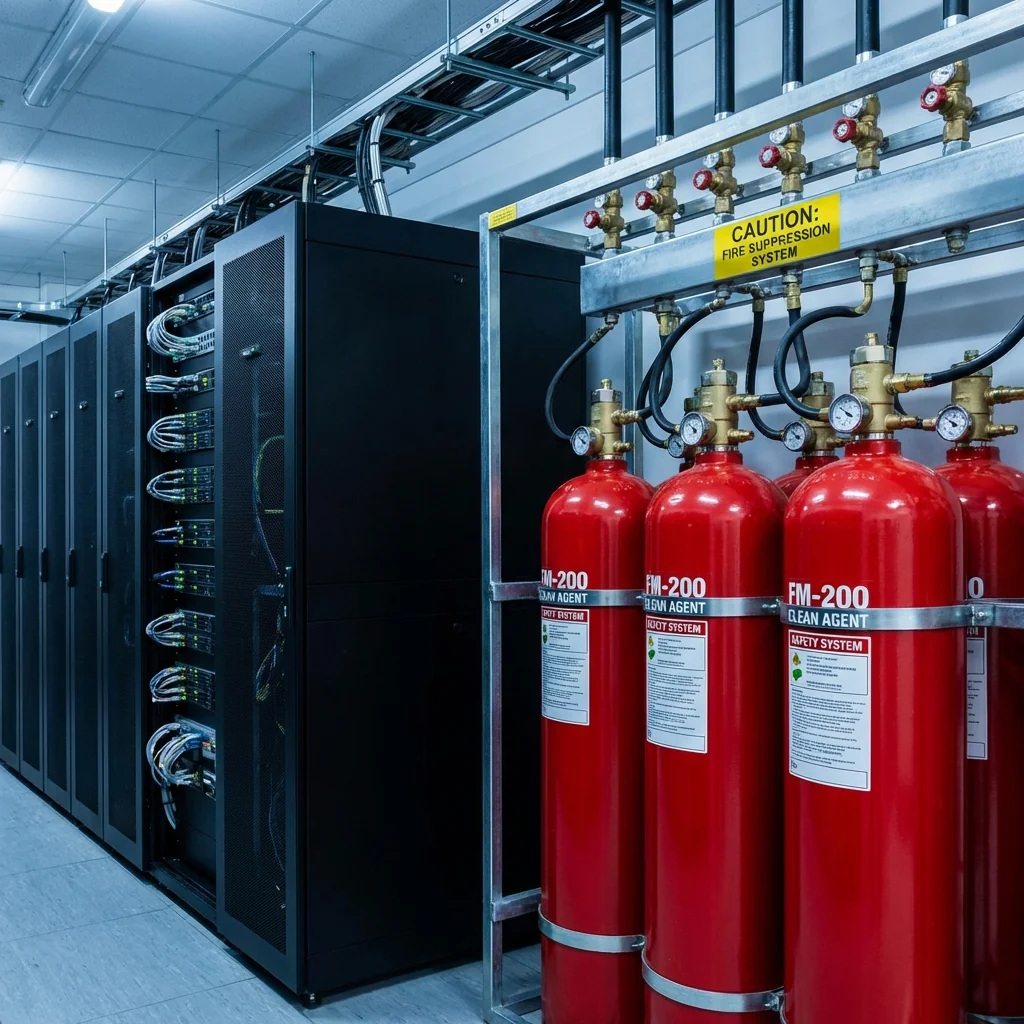
Why Standard Fire Suppression Cannot Protect Server Rooms
Why standard methods fail:
- Water from sprinklers destroys electronic equipment on contact, often causing more damage than the fire itself
- Dry powder extinguishants are corrosive and leave residue that contaminates every surface, making servers and networking equipment unrecoverable
- CO2 requires full evacuation before discharge because concentrations high enough to extinguish fire are also fatal to humans
- The sudden cold expansion from CO2 can cause thermal shock damage to sensitive hardware
How clean agent systems work Clean agent systems avoid all of these problems. They extinguish fire through:
- Heat absorption
- Molecular interruption of the combustion chain (for chemical agents)
Benefits of clean agent systems:
- Reach extinguishing concentration within 10 seconds of actuation
- Leave absolutely no residue
- Safe for occupied spaces at design concentrations
- Room can be re-entered within minutes of discharge
- Equipment can be assessed quickly
- Facility returns to operation faster than with alternative suppression methods
For Dubai's growing base of data centres, telecommunications rooms, and critical IT infrastructure, clean agent protection is the standard — and DCD expects it.
FM200: The Established Standard
What is FM200? FM200 — chemically known as HFC-227ea — has been the industry-standard clean agent for server rooms since the 1990s. It replaced Halon 1301 after that was banned under the Montreal Protocol for ozone-depleting properties.
Environmental impact FM200 has zero ozone depletion potential. However, it carries a Global Warming Potential of approximately 3,220. This figure has led some building owners and ESG-focused organisations to consider alternatives.
How FM200 works FM200 is stored as a liquefied gas in pressurised cylinders. On actuation, it discharges as a gas and floods the protected enclosure to a design concentration of approximately 7 to 9 percent by volume.
At this concentration, it extinguishes fire through:
- Physical cooling — absorbing heat from the flame zone below combustion threshold
- Chemical interference with the free radical chain reactions that sustain combustion
Performance and safety The full design concentration is achieved within 10 seconds. This meets the NFPA 2001 discharge requirement. FM200 is safe for human occupancy at design concentrations. However, pre-discharge warnings and evacuation protocols remain good practice and are required by DCD.
A complete FM200 installation includes:
- Agent cylinders sized for the protected volume
- Stainless steel distribution pipework with precision-calculated flow characteristics
- Ceiling discharge nozzles
- Dual-zone smoke detection system with double-knock logic to prevent false discharge
- Dedicated suppression control panel with abort function
- Pre-discharge sounders and strobes providing a 30-second warning
- Door seals and dampers to maintain enclosure integrity for effective total flooding
Novec 1230: The Low-Environmental-Impact Alternative
What is Novec 1230? Novec 1230 — 3M's trade name for the fluoroketone compound FK-5-1-12 — was developed to provide a lower-environmental-impact alternative to FM200. It delivers equivalent fire suppression performance.
Environmental advantages
- Global Warming Potential is 1, compared to FM200's 3,220
- Atmospheric lifetime is approximately 5 days versus FM200's 34 years
When to choose Novec 1230 For organisations with:
- Formal ESG commitments
- Sustainability reporting obligations
- A preference for future-proofing against potential F-gas regulations
Novec 1230 is an increasingly compelling specification.
How Novec 1230 works Novec 1230 suppresses fire primarily through physical heat absorption rather than chemical chain-breaking. It is stored as a low-pressure liquid and discharges as an extremely fine mist that vaporises instantly.
How it works:
- Absorbs large quantities of heat from the flame zone
- Extinguishes fire with minimal thermal stress to surrounding equipment
- Design concentrations are lower than FM200 — typically 4 to 6 percent by volume
- Fewer cylinders are required for the same room volume
- This can partially offset the higher per-kilogram cost of the agent
Both agents are DCD-accepted in Dubai, and both require the same fundamental system components, design standards, and annual maintenance obligations.
DCD Requirements and the Enclosure Integrity Test
Design requirements All server room fire protection Dubai installations must be designed by a DCD approved contractor. Requirements include:
- Complete shop drawings
- Agent quantity calculations
- Equipment schedules submitted for DCD plan approval before installation
System requirements The installed system must:
- Achieve required design concentration throughout the protected volume within 10 seconds
- Provide a minimum 30-second pre-discharge warning
- Connect to the building fire alarm panel
- Be maintained under an annual maintenance contract by a DCD-licensed contractor
Enclosure integrity test One requirement is frequently overlooked. It frequently causes commissioning failures. This is the enclosure integrity test, also known as the door fan test.
How the test works:
- Pressurises the protected room
- Measures air leakage through gaps around doors, cable entry points, raised floor openings, and HVAC dampers
- Uses data to calculate whether the room can hold agent at or above design concentration for the required soak time (typically 10 minutes)
Common failure reasons:
- Unsealed cable penetrations
- Gaps beneath raised floors
- Improperly dampered HVAC connections
Why this matters Identifying and sealing these leakage paths before commissioning is critical. This is a critical part of the installation process. It is also one of the most common sources of delay on poorly managed projects.
Frequently Asked Questions
Q: Is FM200 or Novec 1230 better for a server room in Dubai?
Choose FM200 if:
- You have a standard server room or small data centre
- You want lower agent cost
- You prefer a well-established local supply chain
Choose Novec 1230 if:
- Your organisation has ESG commitments
- You have a larger data centre
- You operate a co-location facility where environmental credentials are formally reported
Both are DCD-accepted and both deliver equivalent suppression performance.
Q: What is the enclosure integrity test and why does it matter?
The door fan test measures how quickly a protected room loses pressurisation through gaps and penetrations. It uses that data to calculate whether the room can retain discharged agent at extinguishing concentration for the required soak time.
Why it matters If the room leaks too rapidly, agent concentration falls below the extinguishing threshold before the fire is fully controlled. Re-ignition can occur. DCD and NFPA 2001 require this test:
- At commissioning
- After any significant construction work in the protected space
Q: How often does a clean agent suppression system need to be maintained?
Annual maintenance is the minimum DCD requirement.
Maintenance includes:
- Cylinder weight and pressure checks
- Valve and actuation mechanism inspection
- Pipework and nozzle condition
- Full testing of detection and control systems
QSERV recommends semi-annual functional testing of detection and alarm circuits for critical facilities. All maintenance must be performed by a DCD-licensed contractor. Records must be retained for DCD inspection.